Every agent I’ve watched in production has the same moment of truth. It proposes an action. The human looks at it. Then the question hangs in the air: do I let this run or stop it?
That pause is where approval gates live. Too many teams treat them as a concession — a brake you install because you don’t trust the system yet. That framing gets the pattern backwards.
An approval gate is not a speed limit. It is a product feature that enables safe autonomy at scale.
The pattern, plain
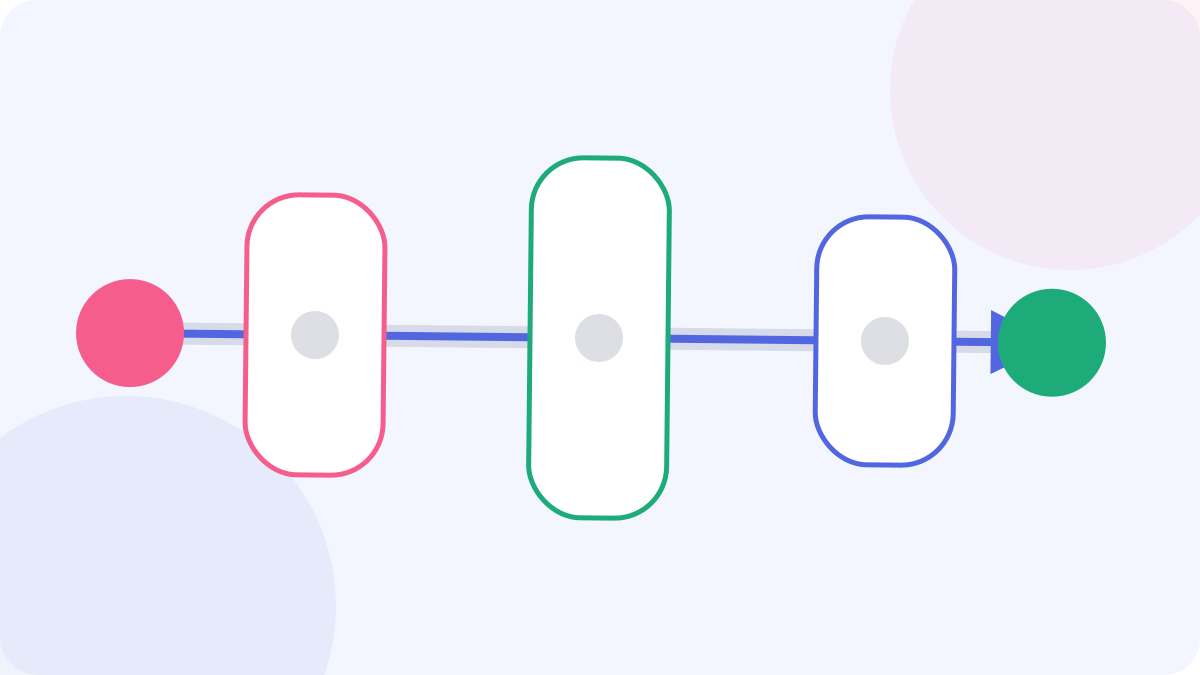
The approval-gate pattern follows a clean loop: proposal, preview, human approval, execution, log, rollback.
The agent drafts an action. It shows the human a preview — the diff, the API call, the config change. The human approves or rejects. If approved, the agent executes, logs the result, and makes a rollback path available. If rejected, the agent learns nothing except that this particular path was wrong for now.
This is not a brake. It’s a decision node. The agent keeps moving; the human just says yes or no at the one point where a wrong answer costs more than a second of attention.
Why it’s a feature, not a brake
The alternative is full autonomy: the agent executes everything and the human audits the log afterward. That works for reversible, low-cost actions — sending a notification, querying a read-only endpoint. It fails when the cost of a mistake is high and the recovery path is long.
Approval gates solve a specific behavioural problem. People stop paying attention when they believe the system is reliable. Over-reliance doesn’t announce itself; it looks like time saved until the one case where the answer was confidently wrong and nobody was still checking. The tool didn’t fail there. The attention did.
An approval gate forces the attention back to the critical juncture. It doesn’t slow the agent down — it slows the decision down, which is exactly where the speed should be traded for certainty.
The risk context
Two frameworks make the case for approval gates concrete.
The NIST AI Risk Management Framework doesn’t prescribe a specific control, but its companion profile for generative AI is clear: human oversight is a risk-management function, not a trust fall. The question isn’t whether the model can do the task; it’s whether the organisation can tolerate the consequences of a mistake in that context.
The OWASP LLM01 risk on prompt injection sharpens the point. A prompt injection can alter model behaviour in ways that no amount of prompt engineering fully prevents. The control is not better prompting; it’s a human checking the output before it touches a production system. An approval gate is that check — not a workaround for a fragile model, but a structural guard against an irreducible class of failure.
When autonomy is appropriate
Not every action needs a gate. The pattern works best when you separate low-risk, reversible actions from high-stakes decisions.
A content agent summarising an internal document? Let it run. An infrastructure agent proposing a terraform apply that changes a production load balancer? Gate it. The distinction is consequence, not capability. If you can roll back in one click and the blast radius is a single user, autonomy is fine. If recovery takes a team and a post-mortem, gate the action.
Keeping velocity
The objection is predictable: “This kills our agent’s speed.” It doesn’t — if you design the gate for the human, not the system.
Async approvals let a human review a Slack notification and approve from their phone. Templates let an agent pre-fill the approval request with the exact diff and the rollback command. Rollback is part of the gate — if the human approves and the result is wrong, they can say “roll back” and the agent reverses the action without a new proposal cycle.
The speed cost is the time it takes to read one diff and tap yes. That’s not a brake. That’s the cost of knowing the system won’t do something you didn’t intend.
Approval gates are a trust mechanism, not a speed limit. They let you run agents at high autonomy where mistakes are cheap, and slow down exactly where the cost of a mistake is higher than the value of a few seconds saved. That’s not a concession. That’s product design.